How to Exchange XMR for USDT: Addresses, Confirmations, Networks, and Limits

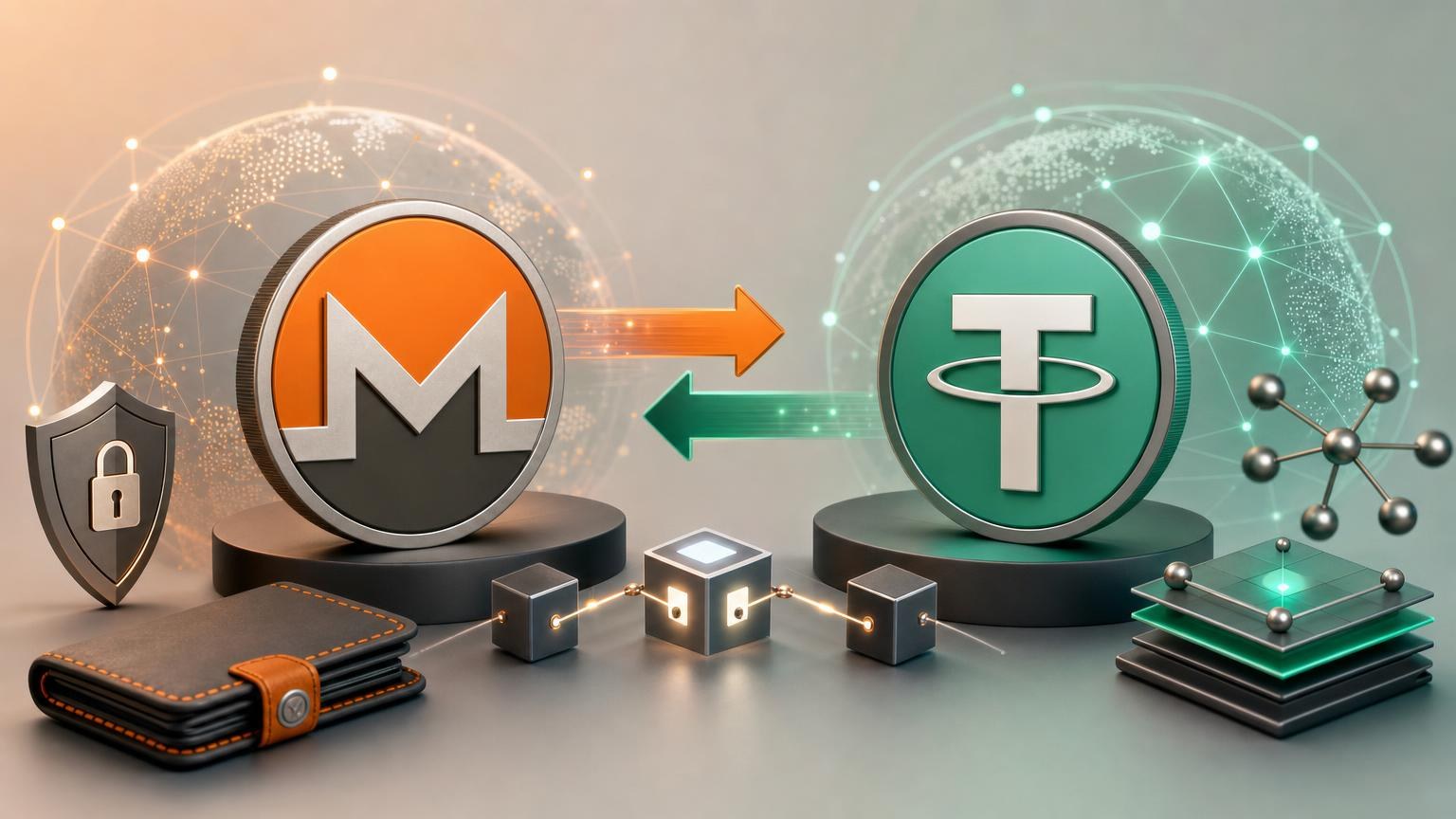
Use this term map before creating an XMR-to-USDT order. It separates the deposit address from the payout address, the asset from its blockchain network, and an on-chain confirmation from the exchange service’s final status. Those distinctions help prevent the most costly errors: sending XMR to the wrong address, selecting an unsupported USDT network, or assuming that a visible transaction is already credited.
Essential XMR-to-USDT glossary
- XMR
- Exact meaning: the native coin of the Monero blockchain. In plain language: XMR is the asset you send when exchanging Monero for USDT. Where it appears: in the source-asset field, wallet balance, deposit amount, and transaction details. Decision affected: confirm that the order requests XMR on the Monero main network rather than another asset with a similar ticker.
- USDT
- Exact meaning: a token issued on several supported blockchains rather than a blockchain network of its own. In plain language: “USDT” identifies the asset, but not the route used to deliver it. Where it appears: in the destination-asset field and your receiving wallet. Decision affected: choose a USDT network supported by both the exchange direction and the receiving wallet. Tether documentation confirms that Tether tokens use the transaction systems of the blockchains on which they are issued. [1]
- Blockchain network
- Exact meaning: the distributed system that validates and records a transaction. In plain language: the network is the rail on which a coin or token moves. Where it appears: in withdrawal settings, deposit instructions, wallet account names, and explorer records. Decision affected: never infer the USDT network from the ticker alone; copy the network specified in the order and verify that the destination wallet supports it.
- Monero deposit address
- Exact meaning: the public Monero address generated or displayed for receiving the XMR attached to an order. In plain language: this is where you send XMR, not where you receive USDT. Where it appears: in the order instructions, often as a long text string and possibly a QR code. Decision affected: compare the beginning, ending, and several middle characters after pasting it into the wallet. Monero supports standard addresses, subaddresses, and integrated addresses; an integrated address can contain a payment identifier used by automated services. [2]
- USDT receiving address
- Exact meaning: the public address to which the exchanged USDT should be delivered on the selected network. In plain language: it is your payout destination. Where it appears: in the exchange form and the receiving section of your wallet or platform account. Decision affected: verify the address and network as one pair; a syntactically valid address may still be unusable for the selected route.
- Payment ID or integrated address
- Exact meaning: a Monero mechanism that can help a receiving service associate an incoming payment with the correct account or order. In plain language: it is an identification detail, not an additional payment. Where it appears: it may be embedded in an integrated address or explicitly referenced in deposit instructions. Decision affected: follow the order exactly. Do not add a Memo, Tag, or Payment ID unless the displayed instructions require one, and do not remove an identifier embedded in the supplied address. Monero documentation distinguishes its technical payment identifier from a business order or invoice number. [3]
- Network fee
- Exact meaning: the amount paid to have a blockchain transaction processed. In plain language: your wallet may deduct a fee when sending XMR, so the recipient must still receive the amount required by the order. Where it appears: in the wallet’s transaction review and the final transaction record. Decision affected: check whether the entered amount is the amount being sent or the amount arriving. Monero states that the sender pays the transaction fee and that the fee can depend on transaction data size and network conditions rather than simply on the amount transferred. [4]
- Gas
- Exact meaning: a network execution fee used by some smart-contract blockchains. In plain language: receiving USDT and later sending it are separate actions; a later transfer may require the network’s native coin for fees. Where it appears: in a compatible wallet when preparing an outgoing token transaction. Decision affected: before choosing a USDT network, check how you will use the tokens afterward and what native asset that network requires. Do not apply the term “gas” to the Monero transfer itself; Monero presents its cost as a transaction fee.
- Confirmation
- Exact meaning: evidence that a transaction has been included in a block, followed by additional blocks added after it. In plain language: a broadcast XMR transaction is pending first and gains confirmations after miners include it in the blockchain. Where it appears: in the wallet, order status, or a compatible explorer. Decision affected: wait for the threshold required by the exchange order rather than assuming that the first visible confirmation is sufficient. Monero documentation defines the confirmation count as the number of blocks mined since the transaction was included in a block. [4]
- TXID
- Exact meaning: the transaction identifier assigned to a blockchain transaction. In plain language: it is the reference used to locate and track the XMR transfer. Where it appears: in wallet history after the transaction has been sent and in order-support workflows. Decision affected: save the XMR TXID and compare it with the transaction associated with the order. Because Monero hides important payment details from public observers, a TXID alone does not publicly reveal the same sender, recipient, and amount data available on transparent blockchains. [4]
- Liquidity and slippage
- Exact meaning: liquidity is the available capacity to complete an exchange at quoted market conditions; slippage is a difference between an expected rate and the effective execution rate. In plain language: a larger or delayed exchange may not necessarily settle at the first indicative figure you saw. Where it appears: in rate terms, quote details, or the final amount calculation if the service provides those fields. Decision affected: read whether the displayed rate is fixed, floating, or otherwise conditional, and review any validity period or adjustment rule actually shown before sending XMR.
- Compliance check
- Exact meaning: a review performed under the service’s applicable transaction-monitoring and customer-verification procedures. In plain language: an order may require additional information depending on the direction and the review result. Where it appears: in the exchange terms, order notices, or a request sent through an official support channel. Decision affected: check current requirements before creating the order. Do not assume that one previous exchange determines the checks applied to another transaction.
Connection map: from XMR to a verifiable USDT result
| Stage | What must match | What to verify |
|---|---|---|
| Object | XMR as the source asset and USDT as the destination asset | The exact direction is currently available; support for both assets does not automatically mean every pair is active. |
| Network or environment | Monero for the deposit and the specifically selected blockchain for USDT delivery | The receiving wallet supports the same USDT network displayed in the order. |
| Action | Send the required XMR amount to the order’s Monero address | The address, amount, and any explicitly required payment identifier match the live order instructions. |
| Confirmation | The XMR transaction is included in the blockchain and reaches the service’s required confirmation threshold | The TXID is valid and the confirmation count progresses; a pending transaction is not yet a completed deposit. |
| Verifiable result | The order records the XMR deposit and sends USDT to the supplied address | The payout has its own transaction identifier on the selected USDT network, and the wallet recognizes that network and token. |
The chain contains two different blockchain transfers: your XMR deposit and the service’s USDT payout. Each has its own address, network context, status, and transaction identifier. A completed XMR transfer proves that the deposit moved on Monero; it does not by itself prove that the separate USDT payout has been broadcast.
Do not confuse these terms
Asset and network
XMR is both the asset ticker and the native coin of Monero, while USDT is a token available on more than one blockchain. Selecting USDT without checking its network leaves an essential part of the payout instruction unresolved. The practical consequence can be a failed credit, a recovery procedure, or permanent loss if the receiving system cannot access tokens delivered through that network.
Deposit address and payout address
The Monero deposit address belongs in the send screen of your XMR wallet. The USDT address belongs in the exchange order as the destination. Reversing them will not create a valid exchange route. Treat both addresses as transaction-specific instructions even if one of them resembles an address used previously.
Public address, seed phrase, and private key
A public address is intended for receiving funds. A seed phrase or private key controls the wallet and must not be entered into an exchange form, sent to support, or shared to “verify” a payment. A legitimate deposit requires the public destination address and an on-chain transaction; exposing wallet secrets can give another party control over the assets.
Transaction and order
A transaction is an on-chain transfer identified by a TXID. An order is the service record that connects your chosen assets, deposit instructions, payout address, and applicable conditions. One order may therefore be associated with an incoming XMR TXID and a separate outgoing USDT transaction identifier. Sending XMR without a valid order, or attaching a TXID from another transfer, can prevent automatic matching.
Blockchain confirmation and order completion
A confirmation describes the blockchain state of one transaction. Order completion means the service has recognized the deposit, applied any required checks, and processed the payout. The two statuses may change at different times. Use the order’s stated confirmation requirement; do not substitute a wallet’s “confirmed” label for the service’s acceptance threshold.
Network fee and slippage
A network fee pays for blockchain processing. Slippage concerns the exchange outcome relative to an expected rate. Increasing or decreasing the XMR transaction fee does not lock an exchange rate, and a rate condition does not replace the blockchain fee. Review these items separately wherever the order displays them.
Practical exchange example
Suppose you hold XMR and want USDT in a wallet that supports a particular USDT network. First, check the current XMR-to-USDT exchange direction. Confirm that the pair and your required payout network are available; the service supports XMR and USDT as assets, but this does not imply that every pair, network, or direction is active at all times.
- Select XMR as the asset you will send and USDT as the asset you want to receive.
- Choose only a USDT network that is shown as available and supported by your receiving wallet.
- Paste your USDT receiving address, then compare it with the wallet’s original address. Do not rely solely on clipboard contents, because malware can replace copied addresses.
- Review the stated amount, rate type, applicable fees, limits, and current compliance conditions. If any of these details are absent or unclear, resolve the uncertainty before transferring XMR.
- Create the order and copy the newly displayed Monero deposit address. Do not retrieve an address from an advertisement, search result, unsolicited message, or previous order.
- In the XMR wallet, verify the deposit address and amount. Add a separate identifier only when the order explicitly supplies and requests one.
- Send XMR and save the TXID. Monero transactions are irreversible after confirmation, so an address error cannot normally be cancelled through the blockchain. [4]
- Monitor both the blockchain status and the order status. Wait until the service records the required confirmations and processes the USDT payout.
- Check the payout transaction on the selected USDT network and confirm that the tokens appear in a compatible wallet account.
How to recognize the terms in a wallet or explorer
- In the XMR wallet: look for the destination address, amount, transaction fee, status, confirmation count, and TXID. Interface labels vary, so verify their meaning rather than expecting one exact layout.
- In the order instructions: distinguish the Monero deposit address from the USDT receiving address you supplied. Check for a required amount, accepted range, confirmation threshold, and any identification detail explicitly associated with the deposit.
- In a Monero explorer: a TXID can indicate that a transaction exists and has been included in a block, but Monero’s privacy design limits the payment details visible to outside observers. Payment verification may require information held by the sender or recipient rather than the TXID alone. [5]
- In a USDT-network explorer: check that the payout transaction belongs to the network selected in the order. The displayed destination should correspond to your receiving address, subject to the way that blockchain represents token transfers.
- In documentation: “supported asset” means that the service works with the asset in at least some contexts. It does not establish that a particular pair, network, amount, or country-specific route is currently available.
Final pre-send checklist
- The current order explicitly shows XMR to USDT as available.
- The selected USDT network is supported by both the exchange direction and the receiving wallet.
- The USDT address was obtained directly from the intended wallet or account.
- The XMR deposit address came from the current order, not an old order or third-party message.
- The amount remains within the limits displayed for that order.
- Any Payment ID or other identifier is used only as instructed.
- The wallet shows the expected XMR amount after accounting for its network fee.
- The current rate conditions, fees, and compliance requirements are understood before payment.
- The domain and page are authentic, with no suspicious redirects or requests for a seed phrase or private key.
- The XMR TXID will be saved until the USDT payout is verified.
The safest workflow is to treat the asset, network, address, and order as one matching set. Verify that set before sending XMR, then use confirmations and transaction identifiers to follow the two on-chain stages separately. Availability, limits, compliance requirements, and supported USDT networks can depend on the direction and current conditions, so the live order terms take priority over assumptions based on an earlier exchange.